And what my 2018 paper warned about
I’ve been watching mainstream discussion of the manosphere for nearly a decade. There’s a pattern that repeats every time a major production tries to make sense of it, and Louis Theroux’s Netflix documentary is only the latest example.
Louis Theroux’s new Netflix documentary, Inside the Manosphere, is already generating the kind of cultural conversation it was designed to provoke. At number one on Netflix within days of its March 11 release, it has been praised for its calm, probing style and condemned—predictably—by several of its own subjects. As a piece of filmmaking, it is vintage Theroux: unhurried, quietly devastating, and very good at letting people expose themselves.
But there is a problem at the documentary’s foundation, and it is the same problem that has plagued academic and journalistic coverage of this space for nearly a decade. Theroux uses the word ‘manosphere’ to describe everything from self-improvement influencers and relationship coaches to men with openly antisemitic and misogynistic views. By treating this spectrum as a single phenomenon, he makes the same analytical error that I warned against in a 2018 paper in Sexuality & Culture—and which, judging by the citations that paper has since accumulated, nobody much heeded.
What the manosphere actually is
When I first began researching this topic around 2017, a colleague at university quipped that ‘the manosphere’ sounded like a gay nightclub. The term wasn’t coined by outsiders—I first encountered it in Ian Ironwood’s 2013 book The Manosphere: A New Hope for Masculinity, which described it as ‘the nascent and evolving collection of blogs discussing topics of masculine interests and men’s issues.’ Ironwood noted that outsiders typically dismissed the whole space as ‘a bunch of cranky old angry conservative men who want to go back to the 1950s.’
What I actually found was more varied. Coach Corey Wayne’s YouTube channel offered practical relationship advice drawing on his book How To Be a 3% Man—covering communication problems and decoding mixed signals to navigating unemployment, issues rarely addressed in mainstream media. Rollo Tomassi’s blog The Rational Male synthesised evolutionary psychology with relationship guidance, spanning parenting and politics. Warren Farrell, a former board member of the National Organization for Women, had become a pariah for researching male disposability—workplace deaths, suicide rates, custody disparities. Christina Hoff Sommers spent decades challenging mainstream feminist claims with data in her video series ‘The Factual Feminist.’ Aaron Clarey mixed financial advice with caustic social commentary in books like Enjoy the Decline, a cynical guide for navigating a world he considered beyond saving.
Ironwood described the movement as ‘a dirty comet hurtling through space’—and the image is apt. The word ‘manosphere’ was always imprecise, but over time its meaning has narrowed: first in academic literature, and now in Theroux’s documentary, it has come to mean the most extreme fringe.
Theroux himself acknowledges the distinction in his Netflix interview—’Many of them are relatively mainstream, but at the edge is a community of figures whose views are much more extreme’—and then proceeds to let the fringe define the whole. Viewers unfamiliar with this space are left with the impression that men who follow fitness influencers or listen to relationship podcasts are participating in the same cultural project as men who circulate antisemitic conspiracy theories. They are not. And conflating them is not just analytically sloppy—it is counterproductive.
What academics (and journalists) missed
When I began researching pickup culture before my 2018 paper Feminism’s flip side: A cultural history of the pickup artist, the academic literature on the subject was remarkably thin—and what existed largely reproduced the same journalistic reflexes, reaching for words like ‘misogynistic’ and ‘pathological’ without asking why the phenomenon existed or what it was responding to. My paper argued that the growth of pickup artist philosophy ran parallel to second-wave feminism’s push for gender egalitarianism, and that understanding this analytically was the only way to make sense of why it resonated with so many ordinary men.
That paper has since been cited sixteen times. The pattern in those citations is telling: most situate it within a framework that treats pickup artists, incels, and men’s rights activists as a single unified movement defined by misogyny—and in some cases as a pipeline to violent extremism. The distinctions I drew have been quietly set aside. The conflation I warned against has become the default position. Theroux’s documentary is, in this sense, less an outlier than a symptom: it has absorbed the assumptions of a literature that stopped asking hard questions some time ago.
Which makes it all the more striking that the documentary inadvertently illustrates one of those hard questions rather well. Costly signaling theory—the evolutionary idea that honest signals must be genuinely difficult to fake, and the framework of my forthcoming book, Costly Signals—suggests that the men Theroux profiles are a textbook case of signal inflation. They exist in a perpetual state of self-presentation. Every sentence is a pitch. Every gesture is content.
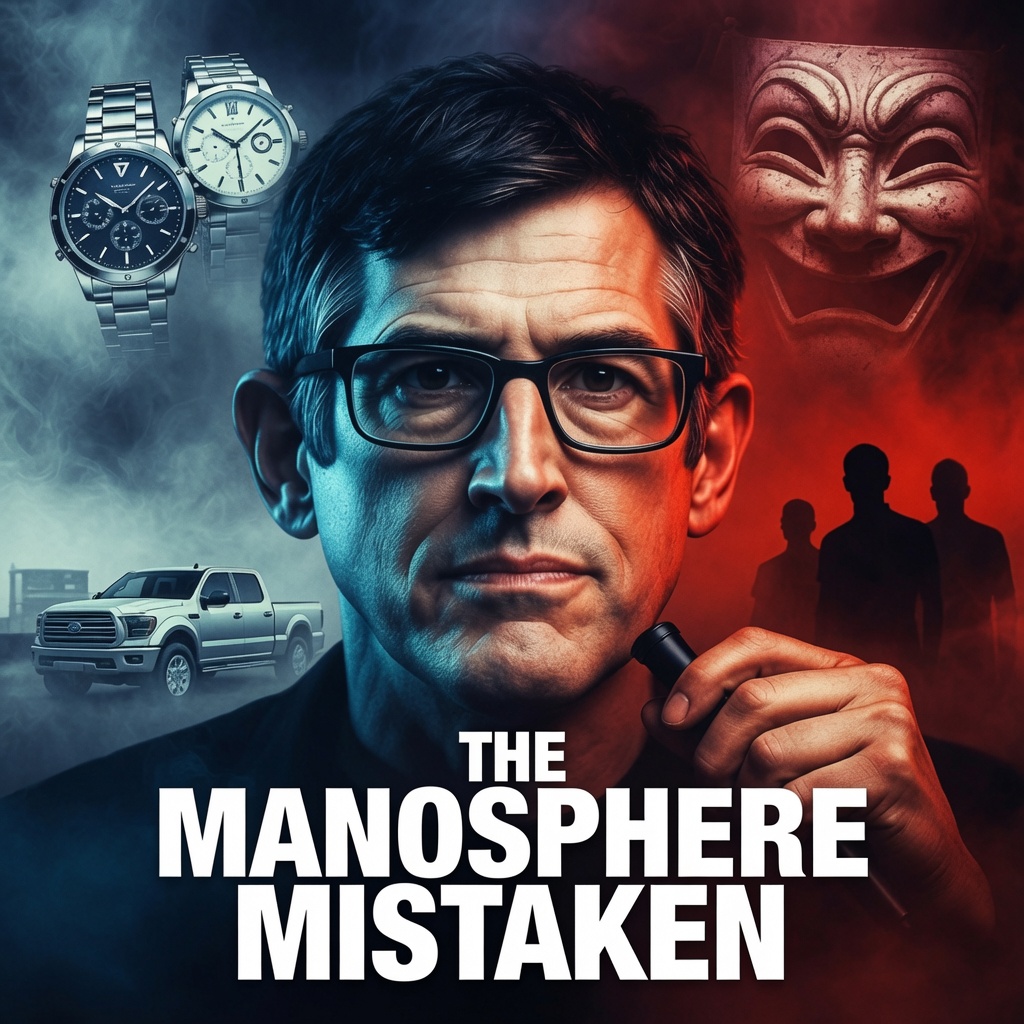
Justin Waller’s Louisiana construction business is real enough, but his role in the manosphere ecosystem depends on the performance of wealth and masculine authority rather than anything genuinely difficult to fake. The watches, the trucks, the alpha-male vernacular are props, not proof. Sneako’s worldview illustrates the same problem: a signal of edgy heterodox thinking completely decoupled from substance. These are cheap signals dressed up as costly ones.
This is the manosphere’s central irony, and one the documentary captures without quite naming it. The entire apparatus of content, courses and coaching calls are all premised on the idea that most men are living inauthentically and need to be shown how to project genuine masculine value. But the influencers themselves are performing a version of masculinity they have monetized, optimized for engagement, and packaged for sale. A man who genuinely has the qualities being sold does not need to spend his days filming reaction content in a Marbella villa.
The women the documentary forgot to ask
There is a second blind spot: the women who appear in the film. Theroux applies his signature gentle persistence to the male influencers—the patient ‘but why, really?’ that has always been his most effective tool. When it comes to the women in these men’s lives, that curiosity largely evaporates.
Kristen, Justin Waller’s partner and a former nurse who left a six-figure career to become a housewife in a one-sided open relationship, offers her account of that choice. Theroux does not push. From an evolutionary psychology perspective, her decision is entirely legible: a mate-choice calculation that trades career status for proximity to a high-status male. Whether it serves her long-term interests is a genuinely interesting question—and one Theroux’s reluctance to ask reflects a broader squeamishness about applying the same analytical rigour to women’s choices that we readily apply to men’s. The manosphere calls it hypergamy; a feminist calls it false consciousness. The more useful question is what it tells us about the current mating market that such arrangements are increasingly common and increasingly visible.
The same curiosity is absent elsewhere. Elaine Sullivan, Harrison Sullivan’s mother, may partially fund her lifestyle from her son’s earnings while remaining visibly uncomfortable with the ideology that generates them—a contradiction Theroux gestures at without pursuing. She is at once beneficiary and critic, and the question of what that position costs her is never asked. Angie, Myron Gaines’s former partner, has since spoken publicly about her relationship with him; she appears in the documentary as a kind of cautionary footnote, but the more interesting question—what drew her to that world in the first place, and what it took to leave it—goes unexplored. In all three cases, the women are present but not really interrogated. Theroux’s reluctance to ask hard questions of women, as opposed to men, could be seen as a form of paternalism, to borrow a famous feminist term.
The documentary Theroux didn’t make
None of this is to say that Inside the Manosphere is without value. As an exercise in access journalism, it is impressive. As a portrait of male vulnerability and its commercial exploitation, it is genuinely moving. The moment where a young fan tells Justin Waller that he has learned ‘life as a man, you’re born without value’ is one of the most quietly devastating things in recent documentary television.
Part of that world includes institutional realities that receive almost no critical coverage in mainstream media. Men account for the overwhelming majority of workplace deaths, rough homeless, and suicides—disparities that attract a fraction of the policy attention devoted to equivalent gaps affecting women. Family courts across western democracies have historically favoured mothers in custody disputes, leaving fathers with limited access to their children and few avenues for redress.
Divorce and alimony laws were also designed in an era of female economic dependence and have been slow to catch up with reality. And while women now outnumber men at university across the English-speaking world, dedicated scholarships and access programmes for women continue to expand—while boys, now the genuinely underrepresented group, receive almost nothing equivalent. These are not fringe grievances. They are documented realities that mainstream media has largely chosen not to interrogate. The manosphere did not manufacture male grievance. It found it already there.
Which raises an obvious question: where is the equivalent documentary about the other side? The online spaces in which anti-male sentiment circulates—call it the femosphere, though the term hasn’t quite stuck—generate content every bit as extreme as anything in Theroux’s film, and attract a fraction of the scrutiny. The 4B movement, which originated in South Korea and spread rapidly across TikTok following Trump’s 2024 election victory, encourages women to swear off dating, sex, marriage, and children with men entirely.
This movement was covered by the New York Times, Marie Claire, and Bustle in tones ranging from sympathetic to celebratory. Hashtags like ‘men are trash’ and ‘male tears’ spawned a cottage industry of merchandise celebrating male suffering, circulating for over a decade on mainstream platforms without attracting the kind of moral panic that greets equivalent content directed at women. Jessica Valenti, one of America’s most prominent feminist writers, tweeted a photo of herself in an ‘I Bathe in Male Tears’ sweatshirt to widespread approval; the idea that a male counterpart might do something similar in reverse requires no elaboration.
The asymmetry here is not incidental. It reflects the same analytical failure the documentary makes: the assumption that scrutiny should flow in one direction only. A Theroux-style film that turned the same quiet, persistent curiosity on this world—asking its subjects why they believe what they believe, what experiences shaped those beliefs, and whether the signals they are sending are genuine or performed—would be at least as revealing, and considerably more surprising to its audience. The manosphere did not emerge from nowhere. It emerged from a conversation that was already only being half-heard.
To find out more about the influence of popular culture and feminism on dating trends, stay tuned for my upcoming book Costly Signals: The Evolution of Dating Advice. My 2018 paper ‘Feminism’s flip side: A cultural history of the pickup artist’ was published in Sexuality & Culture.
Leave a Reply