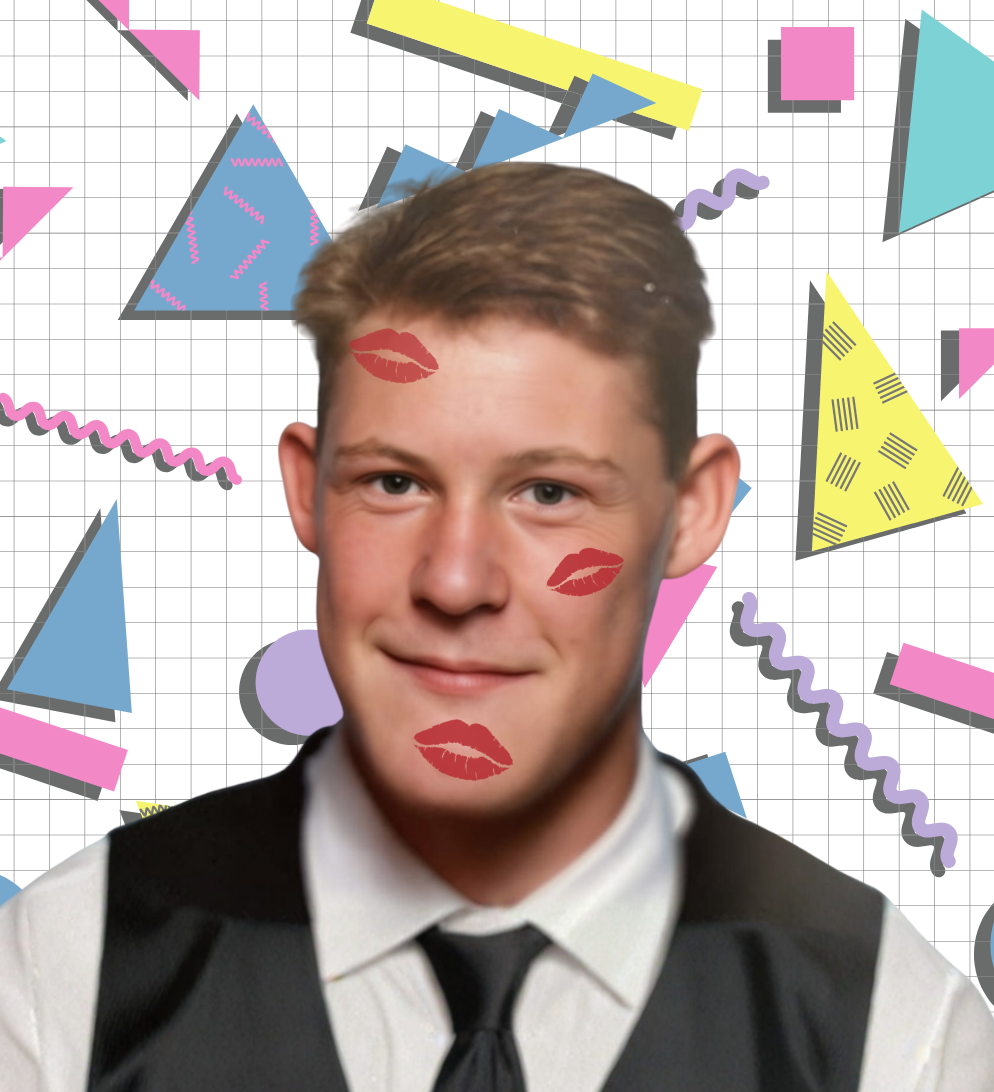
The pre-romantic me, back in the decade of flux
Ah, the late 1980s—when I was just hitting my teenage years, navigating the awkward thrill of first crushes amid a whirlwind of big hair and bigger dreams. Here’s me back then, wide-eyed and hopeful, with a massive crush on a girl named Angela who barely knew I existed. I’d experiment wildly with my look: slathering on gel for the first time to sculpt dramatic center partings one week, then switching to hairspray for gravity-defying flat-tops the next, all in a desperate bid to catch her eye. On TV, I idolized Bruce Willis trading witty barbs with Cybill Shepherd on Moonlighting, imagining myself as that suave, confident hero. But in reality, I was far more like the geeky teens in Weird Science—daydreaming in my room about conjuring the perfect bombshell woman from fantasy, armed only with awkward charm and a Walkman blasting synth-pop anthems.
Those formative years captured the essence of 1980s dating: a mix of bold experimentation, pop culture influence, and utter confusion. With traditional courtship rules upended by social changes, everyone was grasping for guidance—often landing on tips that now seem downright bizarre. Let’s dive into some of the decade’s most peculiar recommendations, straight from the self-help shelves and glossy magazines of the time.
Here are some of the decade’s most peculiar recommendations.
Visualise your perfect partner into existence
The 1980s saw the mainstreaming of New Age thinking, and dating advice absorbed it wholesale. Shakti Gawain’s Creative Visualization (1978) taught readers that thoughts created reality—a premise that self-help authors quickly applied to romance. Louise Hay’s You Can Heal Your Life (1984) extended this further, arguing that affirmations could transform not just your health but also your relationships.
The advice was remarkably literal: write detailed descriptions of your ideal mate, meditate on them, create vision boards, and the universe would deliver. Readers were told to repeat phrases like “I am now attracting my perfect partner” while looking in the mirror, sometimes hundreds of times per day. The assumption was that low self-esteem was blocking love, and sufficient repetition would reprogram the mind.

What made this advice genuinely odd wasn’t the optimism—it was the mechanism. Previous generations understood that finding a partner required doing things: attending social functions, being introduced by family, and demonstrating domestic competence. The 1980s invented the idea that you could attract love through pure mental effort, without changing your behavior or expanding your social world.
Use neurolinguistic programming to make him fall in love
The 1980s saw NLP—neurolinguistic programming—move from therapy rooms into dating advice. Tracy Cabot’s How to Make a Man Fall in Love with You (1985) promised readers they could “make the chemistry of love happen—at will” using psychological techniques. The book was featured on Donahue and Today and covered in Time magazine.

Cabot taught women to identify whether their target was primarily visual, auditory, or kinesthetic in his thinking style, then match their communication accordingly. A visual man wanted to hear “I see what you mean”; an auditory man preferred “that sounds right”; a kinesthetic man responded to “I feel you.” The premise was that speaking someone’s “love language” created instant rapport.
The book also popularized “anchoring”—the NLP technique of associating a touch or gesture with positive emotions. Touch his arm when he’s laughing, the theory went, and later that same touch could trigger the positive feelings. Cabot’s marketing promised readers could “anchor your happiness with a magic touch.”
The strangest advice involved “mirroring”: subtly copying your date’s posture, breathing rate, and gestures to create unconscious rapport. Some practitioners took this to obsessive extremes, matching blink rates and breath rhythms. What made this advice genuinely odd was its mechanical approach to romance—love wasn’t about compatibility or chemistry, it was about executing the correct sequence of psychological techniques. Input the right signals, receive the desired emotional output.
Dress for your colour season
The 1980s produced an explosion of advice connecting appearance to romantic success, but none stranger than the “color analysis” phenomenon sparked by Carole Jackson’s Color Me Beautiful (1980).

The system divided women into four seasonal types—Winter, Summer, Spring, and Autumn—based on skin undertone, hair color, and eye color. Each season had approved and forbidden colors. Winters could wear black and jewel tones; Autumns were restricted to earth tones and rust. Wearing the wrong colors supposedly made you look “drained” and, by extension, unlovable.
Dating advisors incorporated the system enthusiastically. Some books included color analysis chapters, instructing readers to determine their season before any serious husband-hunting. The implication was that a woman might be sabotaging her romantic prospects through injudicious use of coral instead of peach.
The colour season phenomenon was strange not because appearance doesn’t matter in attraction—it obviously does—but because it imposed rigid pseudoscientific categories on what is actually a matter of individual variation and personal taste. A woman who looked radiant in black was told she couldn’t wear it because her “season” forbade it.
Wait by the phone (but strategically)
The 1980s were the first decade when answering machines became household items. After AT&T’s monopoly broke up in 1984, Americans could finally buy their own telephone equipment, and the answering machine suddenly transformed dating logistics.
The technology created entirely new anxieties. Should a woman call a man, or wait for him to call her? How long should he wait after getting a number? The debates that would later be codified in 1990s books like The Rules—which explicitly advised women, “Don’t call him and rarely return his calls” and “Always end phone calls first”—were already percolating throughout the decade.

The potential for romantic catastrophe felt infinite. Leaving a message meant committing your words to tape—no taking it back, no reading the other person’s reaction in real time. And if they didn’t call back, you had no idea whether they’d received the message, were playing hard to get, or simply weren’t interested.
The answering machine’s capacity for disaster was perfectly captured in the Seinfeld episode “The Phone Message” (1991). George, convinced his date is ignoring him, leaves a series of increasingly unhinged messages on her answering machine—only to discover she’s been out of town and hasn’t heard any of them yet. In a panic, he recruits Jerry to help him break into her apartment and physically swap out the cassette tape before she can listen.
The episode’s co-writer Larry David based the storyline on his own experiences—he’d previously pitched a similar sketch to Saturday Night Live that was never produced. That the premise was drawn from real life, and resonated so strongly with audiences, speaks to just how universal this particular anxiety had become. The famous “three-day rule”—wait three days before calling—would later be immortalized in the 1996 film Swingers, but the underlying neurosis predated it by years.
What made 1980s advice so strange?
Looking back, the oddity of 1980s dating advice stemmed from a cultural moment in which old rules had collapsed but new ones hadn’t yet formed. The generation giving advice had come of age before the sexual revolution; the generation receiving it had grown up after. The result was a desperate search for frameworks—any frameworks—that might explain how attraction worked. Neuroscience, pop psychology, color theory, New Age mysticism: all were pressed into service.
Perhaps the strangest thing about 1980s dating advice is how much of it persists. Vision boards for manifesting love. Strategic texting delays (the modern “don’t call him back immediately”). The fundamental confusion about how much agency women should display in courtship continues to generate bestsellers.
The 1980s didn’t resolve the tensions in modern dating advice. It merely invented colorful new ways of expressing them.
My book, Costly Signals: The Evolution of Dating Advice, examines how relationship guidance has evolved as commitment mechanisms changed across different eras. Available soon.
Leave a Reply