On calling cards, costly signals, and buying your way into good society
Open any dating app and you are immediately inside a marketplace of signals. The carefully composed profile photo from an actual trip, the bio that sounds effortless but took an hour to write, the voice note that required three takes—these are modern costly signals. They work, when they work, because they are harder to fake than a generic gym selfie or a one-line “hey.”
Costly-signaling theory, drawn from the biologist Amotz Zahavi, holds that a signal is trustworthy only when it is expensive enough that a cheat cannot profitably fake it. A peacock’s tail is honest because a sickly bird cannot grow one. In 1879 the art stationers of Gilded Age New York understood the same principle and turned it into a business.
The burn test that protected an honest, costly signal
Dempsey & Carroll, “The Art Stationers of America,” operated from Union Square in New York. In 1879 they published a slim volume titled Art Stationery and Usages of Polite Society, written by George D. Carroll of the firm. The book presented itself as a guide to good manners. It was also a catalog—issued gratuitously, as the introduction states, “in connection with our business,” with a promise to revise and reissue it every year.
To the uncultured, according to the book, a coarse sheet bearing a written name is “just as good” as any other card. To the refined, however, the proper visiting card is “indicative of the personal characteristics” of its bearer, advertising “taste and propriety, or carelessness.” Everything about it was calibrated to cost: the finest two- or three-ply board from Pirie & Sons, a precise rose-white tint, script engraving that pointedly did not resemble cheap type.

The firm even reprinted a Home Journal notice pricing its hand-painted dinner cards at two to seventy-five dollars a dozen—real money in 1879. Because cost invites forgery, the book supplied a practical test: set fire to one end. A genuine card charred in a distinctive way; cheap imitations gave themselves away at once. This is costly signaling in action: expensive to produce, hard to fake, and capable of sorting the room before anyone spoke.
Signals of marital status and availability
What the cards sorted, above all, was the marriage market. A young woman’s entry into it was formally staged. After her schooling she was prepared, in the book’s phrase, for her future as one of society’s “ornaments… and heads of households.” Yet she was “not permitted to receive or make visits alone” for a full year, always accompanied by a chaperon.
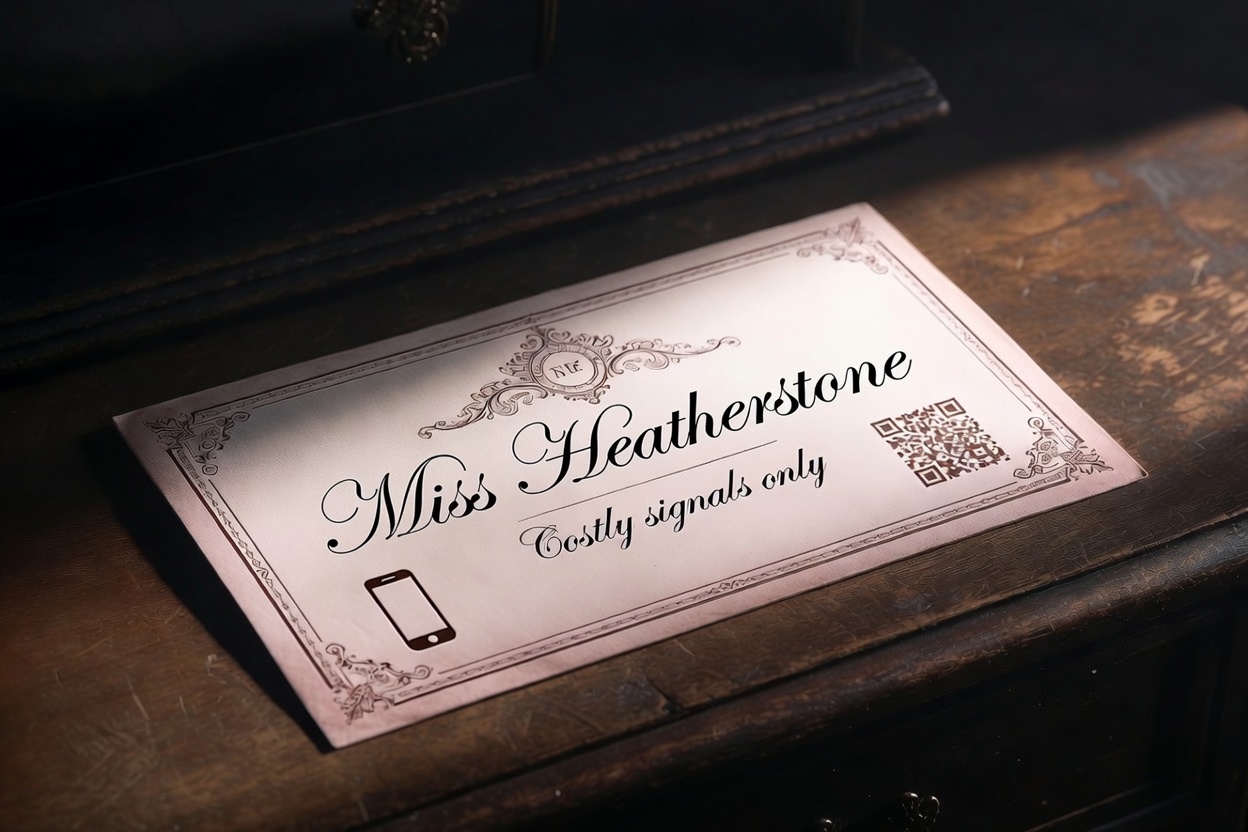
The cards themselves served a precise function in the lives of upper-class Americans. Young ladies’ visiting cards were engraved in a lighter script and printed on smaller stock than those of married women. The eldest unmarried daughter used the simple form “Miss Heatherstone” (just the surname); her younger sisters used their full names (“Miss Georgia S. Heatherstone”). A married woman’s card was intermediate in size and weight between a young lady’s and the joint “Mr. and Mrs.” form, which was itself reserved for only a short period immediately after the wedding.
Together, these differences—size, weight, the formality of the script, and the form of the name itself—made marital status and availability legible at a glance, before the name was even fully read.
Costly signals and honest replies
Courtship ran on the same logic of costly exchange. A gentleman uncertain whether a woman returned his interest left his card at her residence. If the interest was mutual, an invitation to the family followed. The card was a cheap probe; the invitation—requiring time, hosting, and social exposure—was the costly, honest reply.

The system included a visual code. Turning down the right-hand upper corner signified a call; the left upper corner, congratulations; and the lower corners, condolence or farewell. The firm kept “plates with the proper significations engraved upon them” so a customer could buy the coded corners ready-made. French added another filter: an invitation engraved R.S.V.P. was reserved, the book explains, for cases where “a doubt exists as to the invited parties’ knowledge of society etiquette.” The code itself announced who could read it.
When stationers sold the signals
Here the central contradiction of Dempsey & Carroll’s enterprise becomes clear. A handicap signal retains its value only when the cost is real and borne by the sender. Dempsey & Carroll were in the business of bearing that cost for paying customers. They imported the board, engraved the script, supplied pre-coded plates, gave the rulebook away, and pledged to update it annually.
Every move democratized the scarcity that made the signal valuable. Once the cost can be purchased, the card no longer cleanly separates the well-bred from the merely moneyed; it separates those who can afford Dempsey & Carroll from those who cannot. The firm’s own framing is candid: its business is “a necessity to society people,” engraving ranks among “the polite arts,” and knowledge of social customs is one of the “passports to desirable society.” A passport available to any paying customer is already depreciating—which is why the rules had to be reissued every year.
Signal inflation: from engraved cards to curated profiles
The instinct the stationers monetized has not disappeared. They promised anxious readers that they could, for a price, “do the right thing at the right time” and be read as what they hoped to be. The dating-app profile runs on the same impulse: the staged-spontaneous photo, the ghostwritten bio, and the coach who scripts your opening lines all sell a costly signal stripped of its genuine cost.
But the parallel shouldn’t be drawn too neatly, because the modern version inverts the thing that made the Victorian system work. Dempsey & Carroll’s signal was hard to fake—a convincing card was genuinely expensive, and a forgery could be caught by setting fire to one end. On an app, the cost of faking has collapsed. Filters, borrowed photographs, and AI-written bios let almost anyone manufacture the appearance of taste and effort for nothing, and there is no burn test to expose them. Where the calling card was an honest signal being slowly commercialized, the optimized profile is closer to one whose honesty is being competed away in real time.
The truer heir to Dempsey & Carroll is not the freelance photographer but the platform itself. The firm sold the materials of desirability; the app sells its appearance directly—boosts, super-likes, and premium placement that buys visibility regardless of what lies behind it. In both cases a single intermediary profits from the same anxiety, and in both the result is inflation: when the markers of quality can be bought, they stop reliably marking quality, and the genuinely invested must keep raising their costs to stay legible.

None of which makes the signals worthless. A real trip, a genuinely funny bio, a voice note that took three takes still leak information, just as a calling card served a genuinely well-bred Victorian perfectly well. The point is narrower and older than the technology: the honest signal and its forgery have always been sold at the same counter. In 1879 that counter was on the fourth floor of a building on Union Square. Today it sits in your pocket—though for some it is still a shop on Lexington Avenue, where Dempsey & Carroll engraves cards by hand to this day.
This is the pattern traced throughout Costly Signals: The Evolution of Dating Advice. Each era’s dating advice negotiates which displays count as honest and how those displays can be produced. Victorian calling-card etiquette, 1920s sexual technique, 1950s provider stability, and today’s optimized profiles are different currencies, but they serve the same function: filtering for genuine interest and commitment in a market where words are cheap and actions (or their visible costs) still carry weight.
Leave a Reply