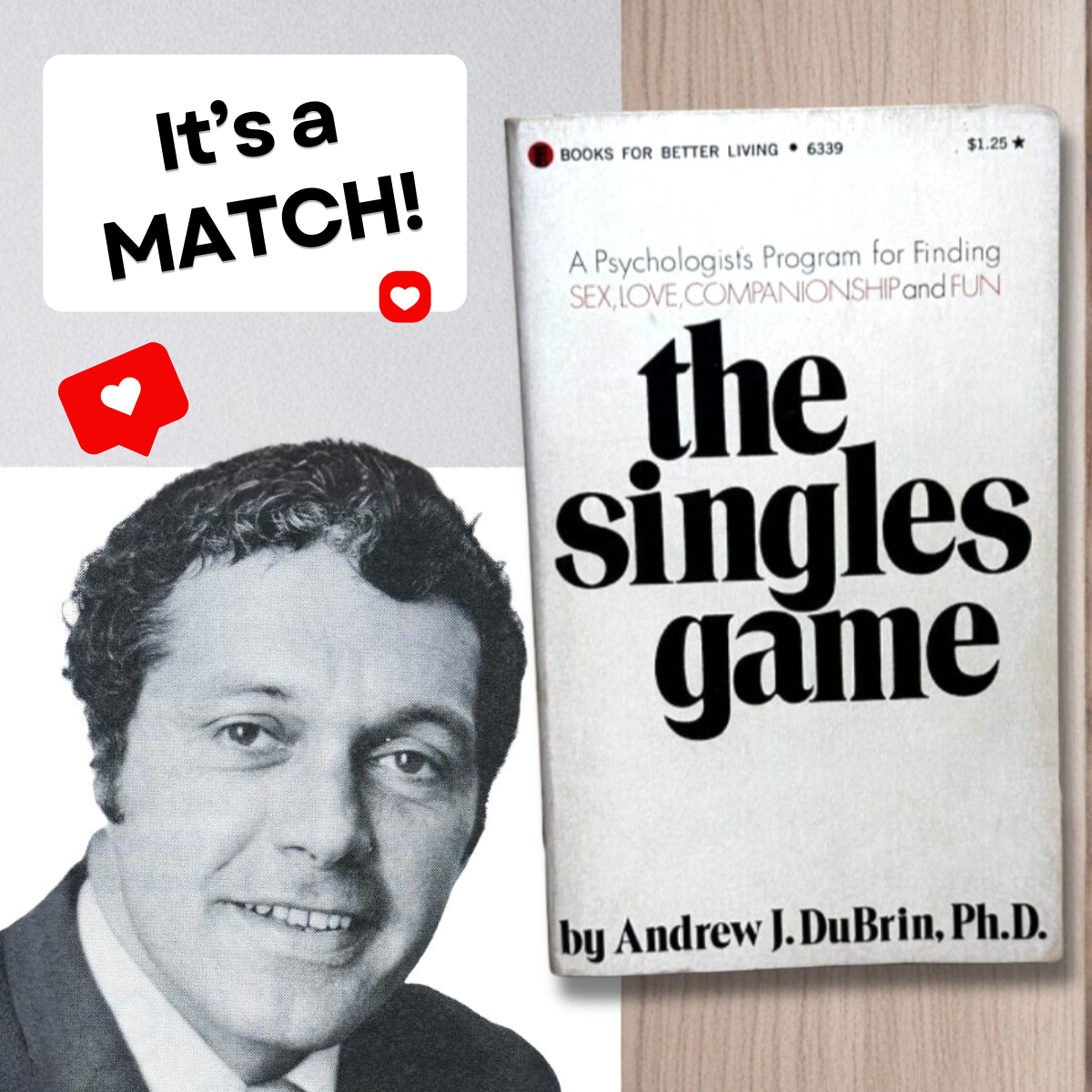
Andrew DuBrin’s The Singles Game, and the application of management theory to dating advice
In 1973, while the rest of America preached free love and “going with the flow,” a management professor in Rochester, New York, was doing something deeply unfashionable: treating dating like a business problem.
Andrew J. DuBrin had a PhD in industrial and organizational psychology, a career focused on leadership and office politics, and a conviction that finding a partner was a skill—not destiny. The result was The Singles Game, published by a tiny California press. The book sank without a trace and has been out of print for over fifty years. Yet read it today and you’ll find something startling: an accidental pioneer of the framework that now dominates modern dating.
DuBrin brought management-speak to the bedroom with zero embarrassment. Singles were “prospecting.” Potential partners were “leads” and “supply.” He even traveled under a pseudonym to research singles bars and early computer dating services, like a consultant doing field research. The dedication page delivers a quiet punchline: he dedicated the book to Marcia, “who changed her surname from Miller to DuBrin in the interim between the writing and the publication of this book.” The man who systematized the singles game had found his own wife while writing the manual.
Portraits of loneliness
The book opens with vivid case studies of people failing spectacularly at the singles game—and these remain some of its strongest pages.
There’s Chet, a 53-year-old auto executive who keeps chasing women half his age. He asks a 22-year-old from the art department for a date. Her reply: “I make it a policy never to date men older than my father. It makes him jealous.” He tries the daughter of a business acquaintance, who tells him to go back to his wife. The next day, her father calls to suggest Chet see the family doctor.
Ray, a 33-year-old Boston stockbroker, negotiates an open marriage and expects the city to fall at his feet. His first office prospect refuses to date a married man. His second dumps him for an ex. At a singles bar he downs eight scotch and waters, meets Eva—a narcotics agent—who sleeps with him in a third-rate hotel, gets evicted from her mother’s house, and later threatens suicide when he doesn’t call back.
Then there’s Eunice, a 43-year-old political science professor in Nashville. Her first post-divorce date, a history chairman, seemed perfect—until he moved in with a 21-year-old home economics major after ten dates. Eunice joined a singles club. A salesman asked what she did, laughed, and said, “Let me know when you run for president; I might vote for you,” before walking away without asking for her number.
DuBrin’s analysis is strategic, not moralistic. Each person was sending the wrong signals to the wrong audience.
The question was never “What’s wrong with you?” but “What’s wrong with your approach?”
Accidental signaling theory
DuBrin’s “Twelve Commandments” read like a signaling theory primer written decades before the theory existed. “Shape Up Your Emotions”—don’t leak neediness early, because desperation signals low mate value. “Check Out Your Plumage”—invest in your physical presentation, since appearance signals underlying condition. “Place Yourself in a Favorable Light”—context shapes perception. A jockey looks ordinary on the beach but irresistible in the winner’s circle.
In 1975, just two years after DuBrin’s book appeared, the biologist Amotz Zahavi proposed the handicap principle in a theoretical paper. He argued that reliable signals must be costly to produce, precisely because that cost makes them hard to fake. Zahavi was thinking about sexual selection and mate choice among peacocks and gazelles; DuBrin was writing about singles bars and opening lines. But the underlying logic was the same: signals work because they’re expensive.
One of the book’s most distinctive sections urges readers to “Calculate Your Odds.” For a woman named Nancy with a list of strict requirements (Catholic, aged 25–30, earning over $27,000, college-educated, single, and attractive), DuBrin multiplies the probabilities and concludes there are roughly twenty eligible men in the entire United States. His advice: drop one or two requirements and your pool expands dramatically. “Every characteristic you require in a prospective lover multiplies your chances of failure,” he warns.
The section on opening lines captures 1970s audacity with practical wit. DuBrin’s top recommendation: “Hello.” His deadpan assessment: “This is a fantastic opening line. Wish I could take credit for it.” He also praises awkward but authentic openers, such as a planned fumble at an art gallery about the difference between a lithograph and a contemporary painting. DuBrin reports that this “planned fumble worked beautifully. She picked up the ball and they are now living together.”
He is equally clear about what not to do. Don’t claim to be an IBM executive when you’re visibly twenty-three. Don’t open with an interrogation (“Where do you work? How old are you? Do you live with your mother?”). The best openers sound natural and spontaneous rather than contrived. A “super-cool” approach makes you sound like a professional operator. A little fumbling, DuBrin argued, signals authenticity.
Costly signals and computer matchmaking, 40 years before Tinder
The chapter on computer dating reads like prophecy written on a punch card. DuBrin examined early questionnaire-based services: fill out a long form covering compatibility factors, pay a fee, and receive a list of names.
Two contrasting stories illustrate the unpredictable results. Sandra, a 35-year-old librarian, paid $250 and was matched with Alan, a widowed lawyer. They met at a family cookout with his four children. Five months later they were married. She later defended computer dating on a radio show: “I paid more for my stereo set than I did for my husband.”
Dave, a 43-year-old math teacher, paid $20 and received six names. One number was disconnected. Another woman had moved. A third refused calls from the service. The fourth agreed to meet him outside her office at 5:15—she described herself as short with dark hair, then never showed. Dave approached ten different women before giving up. The fifth wouldn’t date a separated man. The sixth was initially promising, then spectacularly wasn’t. DuBrin’s verdict: the results were “quite unpredictable.”
The technology was primitive, but the underlying logic—systematic matching based on stated preferences—was sound.
The approach that won
Fifty years later, dating apps are essentially The Singles Game at scale: algorithmic matching, relentless prospecting, calculated odds, and constant optimization of self-presentation. The language has changed. The framework has not.

What DuBrin understood in 1973—without the modern vocabulary to name it—was that dating is fundamentally a signaling problem. Success in the singles game, he argued, depends more on what you do than on who you are. The signals you send through your emotions, appearance, context, and tolerance for rejection matter more than your intrinsic qualities. He framed it as management strategy. Zahavi would have called it costly signaling. Either way, the insight holds: finding a partner is a skill, not destiny.
Marcia Miller, at least, seemed to agree.
For more insights into costly signaling theory in relation to dating advice, from 19th-century grooming manuals to today’s TikTok coaches, stay tuned for my forthcoming book Costly Signals: The Evolution of Dating Advice.
Leave a Reply