
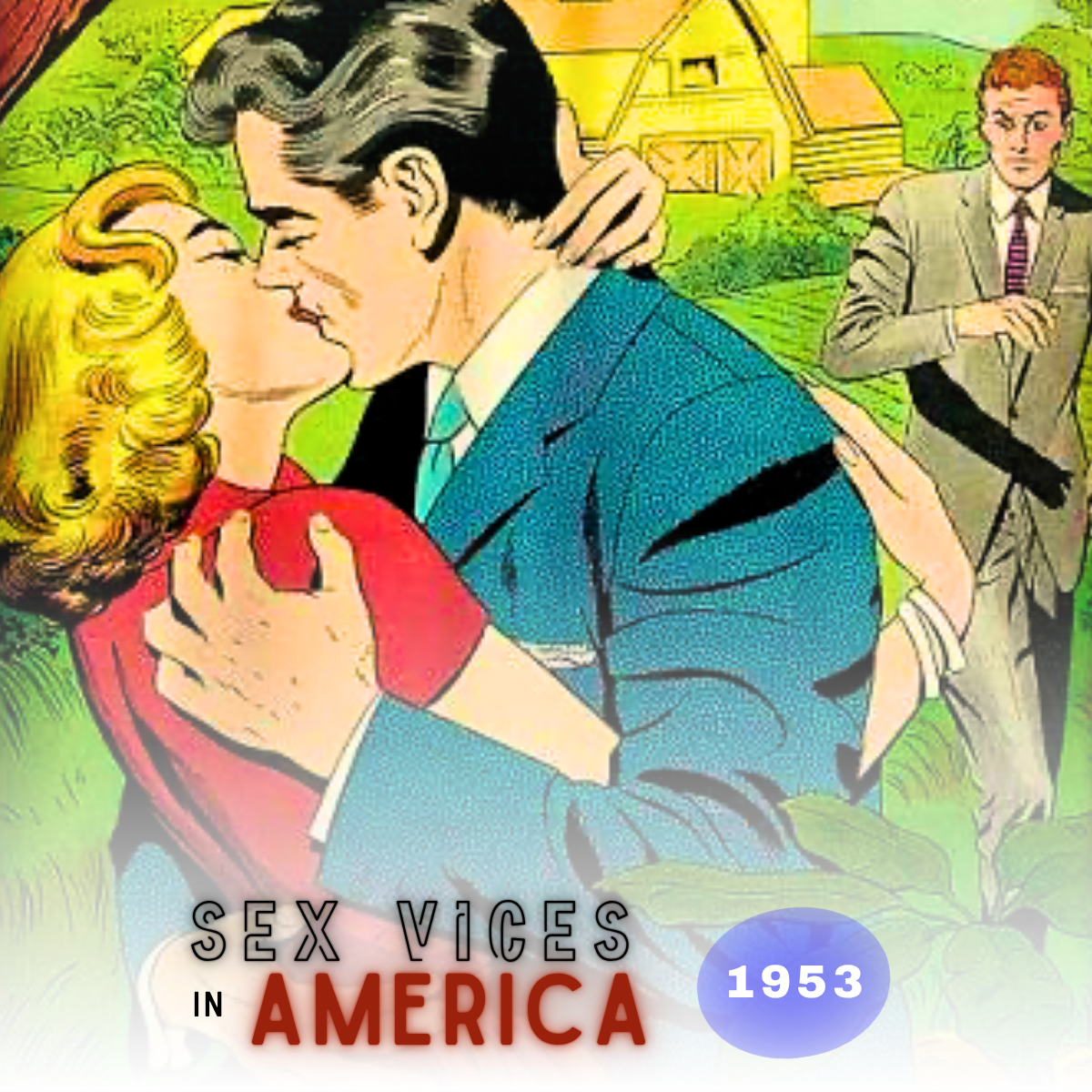
How a 1950s sex manual mistook constrained strategy for female pathology
Chapter Six of Sex Vices in America bears the title “Why Wives Are Unfaithful” — but what it actually describes is something broader and stranger. Lawton and Archer are less interested in affairs per se than in the various ways wives exit marriages, whether through outright desertion, strategic misbehavior or simply infidelity.
Reading the chapter today, one is struck by how thoroughly it positions female sexuality as reactive—women don’t cheat from desire but because something has gone wrong. This framework reveals more about mid-century assumptions than about women themselves, yet buried within it are observations that evolutionary psychology would later formalize with more rigor and less judgment.
Why wives rarely just walked out
Lawton opens with a case study designed to show how unusual straightforward desertion is:
VERY few cases of desertion by wives are as naive or clear-cut as that of Mrs. Emily Rogers of New York. That isn’t her real name, of course. One day Emily disappeared without so much as a note left behind for her bewildered husband.
Emily’s case is presented as exceptional precisely because it was so direct. Most wives, Lawton argues, take a different approach:
Most wives who leave home, however, use much more subtle methods than Emily chose. They have found it easier—financially and morally—to break up their homes by staying in them and deserting their husbands by failing to act as wives. They refuse sexual relations or submit coldly. They behave hostilely or with infuriating indifference. This desertion is so unmistakable that inevitably husbands are goaded into initiating the desired schism.
This concept of “indirect desertion” is fascinating. Lawton recognizes that women face asymmetric exit costs—social stigma, legal disadvantages, economic vulnerability—and therefore develop strategies that position them as the aggrieved party rather than the deserter:
There are innumerable reasons for this peculiar style of wives’ desertion. Primarily, women wish to avoid the stigma attached to the wife who leaves her husband and children. Our hypocritical society is cynically tolerant of runaway husbands—’Oh, you know what men are!’ But no words are considered vile enough to describe the wife who takes to her heels. Especially if she leaves children.
This is essentially an observation about how power asymmetries shape exit strategies—women who want out must manufacture situations where they appear as victims rather than agents.
The five reasons wives left, according to 1950s experts
Lawton presents five categories explaining why wives leave or stray:
Once the real reasons for their dissatisfaction are learned, however, it is often possible to apply remedial measures and effect a reconciliation. A study of thousands of cases indicates that five basic disharmonies are responsible for the desertion of most wives… 1. Basic incompatibility, physical and/or mental. 2. Emotional instability and immaturity. 3. Revolt against the limited horizons of domesticity. 4. Faulty parental training, and in-law interference. 5. Illness, physical and/or mental.
What’s notable is how each category positions female infidelity or desertion as symptomatic—something is wrong with her, her husband, her upbringing, or her circumstances. Autonomous female desire doesn’t appear as a possibility.

Four case studies of unhappy 1950s wives
The chapter is rich with narrative cases that reveal period assumptions even as they document real patterns.
Mrs. Rose Green used alcoholism strategically:
Thus, when a wife we will call Mrs. Rose Green fell out of love with her husband, she didn’t pack her grip and take flight. There were two children. So Rose deserted by a much more effective strategy. She got drunk—and stayed drunk.” The drinking escalated until her husband demanded divorce, “making her the aggrieved party.
Mrs. Louise Cooper illustrates the “emotionally unstable” category — cycles of violence and reconciliation ending when “she and her husband had a bitter quarrel, and he shot her in a drunken rage. She had him put in jail.” But then: “When his sentence was finished, she took him back with her. In short order they were scrapping again.”
Mrs. Emma Torring represents the “revolt against domesticity” type. A farm wife who “lived placidly and happily with her husband in Ohio until they moved east temporarily,” Emma met “a well-groomed druggist” in New York. “He never saw her again, and the National Desertion Bureau is still looking for her.” Lawton’s framing: women exposed to wider horizons may discover their marriages feel constraining.
Anita Gontella exemplifies the “emotional immaturity” pattern:
A very beautiful girl, pampered extravagantly by her family. Men fell in love with her easily, but few would put up for long with her incessant demand for flattery, attention, and gratification of her whims. At the time of writing, Anita has already deserted three husbands.
What 1950s marriage advice got right about female infidelity
Despite the moralizing tone, several observations align with what evolutionary psychology would later describe more systematically.
Conditional mate-switching: Lawton notes that women rarely leave without a secured alternative:
Wives seldom allow themselves to become infatuated with another man, unless they have first fallen out of love with their husbands. Once this happens, however, many do look around for another possible partner. Especially where there are children, the wife is usually cautious about abandoning her unhappy security until a new home and marital status are assured her.
This describes strategic female mate-switching — not random infidelity but reorientation when current mate value declines, with particular caution when dependent offspring are involved.
Hypergamy and opportunity: The Emma Torring case illustrates how exposure to higher-status alternatives can destabilize existing pair bonds. Lawton frames this as weakness; evolutionary psychology would frame it as rational response to new information about available mates.
The “other man” as symptom: Lawton consistently argues that affairs follow rather than cause marital breakdown. Affairs emerge when marriages are already failing, not as bolts from the blue.
What 1950s marriage advice got wrong about female desire
The reactive model of female sexuality: The entire framework assumes women cheat because something is wrong—never from autonomous desire or attraction. When discussing male infidelity in Chapter Eight, “variety seeking” appears as a legitimate psychological cause. No parallel exists for women. Female sexuality is always responsive to circumstances, never generative.
Pathologizing female ambition: Women who leave unsatisfying marriages for independence are coded as suffering from “revolt against the limited horizons of domesticity”—as though wanting more than housework were a psychiatric symptom. The possibility that some marriages were legitimately stifling is acknowledged but framed as the woman’s failure to adjust to appropriate expectations.
Ignoring male behavior as cause: While Lawton occasionally notes abusive or neglectful husbands, the analytical weight falls on female psychology. A case involving a husband who “beat her physically” gets brief mention; the wife’s “instability” in repeatedly returning gets extensive analysis.
A divorce lawyer’s view: is anyone really at fault?
Lawton quotes matrimonial lawyer Charles Rothenberg on the difficulty of determining fault:
Wives who desert can be overwhelmingly convincing,” attorney Rothenberg told us, “until you listen to their husbands. And all too frequently you discover that neither is really at fault, but that the blame lies with society itself.
This is a surprisingly modern note—acknowledging that individual pathology explanations may miss structural factors. But Lawton doesn’t develop it, returning instead to cataloguing female dysfunction.
What the 1950s still tells us about why wives cheat
The 1950s framework for understanding female infidelity reveals more about period assumptions than about female sexuality itself. The insistence that women only cheat reactively—never proactively—reflects a model where female desire is always responsive to male behavior or circumstance.
Yet buried within the moralizing are observations about mate-switching strategies, opportunity costs, and hypergamic calculations that evolutionary psychology would later develop with more rigor and less judgment. Lawton noticed that women with children are more cautious about leaving, that secured alternatives typically precede departure, and that affairs usually signal pre-existing marital breakdown. These patterns are real.
What the 1950s advisors saw as pathology, we might now recognize as strategic behavior under constraint. The woman who manufactures grounds for divorce rather than simply leaving isn’t “emotionally unstable”—she’s navigating a system where direct exit carries prohibitive costs. The wife who waits until she has another option lined up isn’t “calculating”—she’s rationally managing risk in an environment where unmarried women faced severe economic penalties.
The framework was wrong about female agency but inadvertently documented the constrained optimization that women actually performed. Strip away the moral judgment, and what remains is a record of how women navigated pair-bond dissolution when the rules were stacked against them.
To discover more about the history of relationship advice, and cheating, stay tuned for my upcoming book Costly Signals: The Evolution of Dating Advice. Also, follow me on X @Andrew_S_King for more dating and mating insights.
Leave a Reply