From panic bouquets to quiet presence: how February 14th grades your mate value
Every year around the middle of February, a familiar anxiety settles over men in relationships. What do I get her? Is a card enough? Are roses too predictable? According to Mintel, 52% of Valentine’s Day shoppers admit that last-minute buying leads them to spend more than they intended—rising to 67% among those aged 16 to 34. That’s not just poor planning. That’s panic, and panic is its own kind of signal.
Because Valentine’s Day is, at bottom, a mass-scale fitness test. In evolutionary psychology, costly signals are behaviors that reveal genuine underlying qualities precisely because they are difficult to fake. In the animal world, a peacock’s tail or stag’s antlers are costly. For humans it’s a Rolex watch or a sports car. More prosaic costly signals might be sitting through a two-hour candle-shopping expedition at TK Maxx without checking your watch or watching your man explain the offside rule for the third time while pretending it’s finally clicked.
For rich and poor alike, the way someone navigates Valentine’s Day—that’s costly too, though not always in the way you’d expect.
Why Valentine’s Day is an evolutionary fitness test
The numbers bear this out. In the UK, men plan to spend an average of £57, compared to women’s £41. In the US, the gap is starker: men budget roughly 40% more than women. This maps neatly onto Robert Trivers’s parental investment theory, which predicts that the sex investing less in offspring will compete more intensely for mating opportunities—and one form that competition takes is costly display. Men aren’t spending more because they’re more generous. They’re spending more because the holiday activates an ancient signalling dynamic: demonstrate your willingness to invest.
What makes February 14th so revealing is the artificial deadline. It forces everyone in a relationship to demonstrate attentiveness (do you know what your partner values?), planning (did you think ahead?), and calibration (can you read the situation?). These are proxies for exactly the kind of cognitive and emotional investment that matters in a long-term partner. And partners, whether consciously or not, are reading the signal.

How you’re being graded on Valentine’s Day
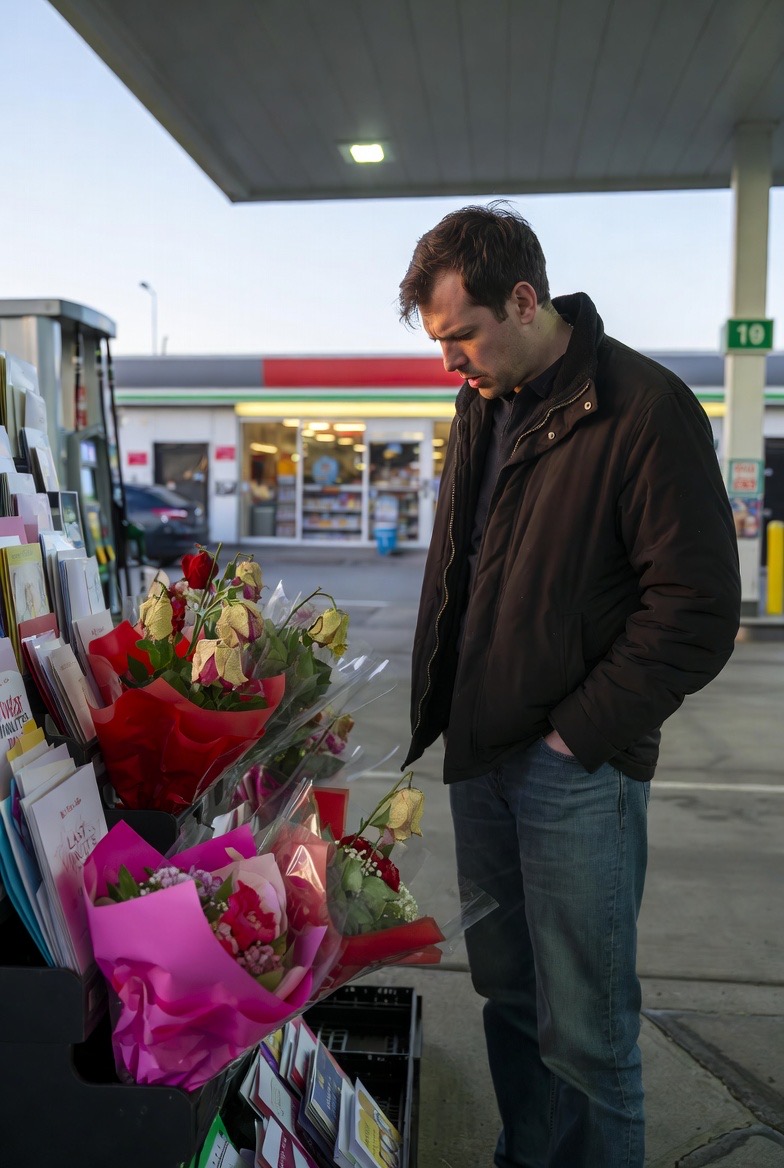
Consider the taxonomy of responses. The panic buyer—spotted at the petrol station on the evening of the 14th, grabbing a wilting bouquet—is broadcasting something, but what? To one partner, it signals a lack of foresight. To another, it’s endearing: here is someone whose life is genuinely full, who still made the effort. The Mintel data suggests these buyers aren’t indifferent—they’re anxious. And anxiety, in its own clumsy way, is a signal of caring.
Then there’s the person who “doesn’t do Valentine’s Day.” They’re not alone: 59% of British men say the celebrations are pointless, and a quarter of Americans in relationships don’t plan to spend anything. This could be genuine—a partner who shares that view might find the refusal attractive, a signal of independence and authenticity. But for a partner who values the gesture, the same refusal signals something else: effort reframed as philosophy. Same behavior, different audience, completely different signal.
The by-the-book response—restaurant, roses, card—is a safe signal. It says, “I showed up; I did the thing.” For some, reliability is its own costly signal, one that says, “I will keep doing this, year after year, without being asked.” For others, the safety is the problem. It’s generic. The roses could be for anyone.
And then there’s the specific gesture—the obscure book mentioned in passing, the plan that reflects a person rather than a holiday. This signals sustained attention and cognitive investment. It’s powerful precisely because it can’t be faked. But even this isn’t universally “correct.” Some would find this level of attentiveness pressuring—a signal of investment that implies expectations they’re not ready for.
The point isn’t that any response is objectively right or wrong. It’s that Valentine’s Day forces each one into the open. Everyone must do something—even doing nothing is a choice—and the thing they do becomes legible. Different people screen for different qualities. The question isn’t whether you passed. It’s what the test revealed.
Valentine’s Day spending as a costly signal
Perhaps the most interesting data, from a costly signalling perspective, is how spending changes over a relationship. Couples together less than a year budget around $150 for Valentine’s Day. After five years, that drops to $100. A LendingTree study found an even steeper curve: partners of less than two years spent $369 on average, while those together for over a decade spent $118.
You could read this as love fading. Costly signalling theory offers a more generous interpretation. In the early stages, the signal needs to be loud because the receiver has less information. You are, in effect, advertising. As trust accumulates through thousands of daily micro-signals—the way someone handles a crisis, remembers an appointment, shows up consistently—the need for a dramatic annual display diminishes. The signal has already been sent and received, many times over, in forms far more reliable than a prix fixe dinner.
The Valentine’s Day paradox
There’s also an irony built into the holiday. A truly costly signal must involve genuine cost—something that can’t be easily replicated. But Valentine’s Day, by turning romantic gestures into obligations, reduces the costliness of the signal. When everyone is expected to perform, performance tells you less. A dozen red roses on February 14th is a weaker signal than a dozen red roses on a random Wednesday in October. The first says, “I followed the calendar.” The second says, “I was thinking about you for no reason at all.”
This is why 48% of people say their preferred Valentine’s gift is simply quality time at home. What they’re really saying is, “Don’t perform for me. Just be present.” Presence, freely given, is the costliest signal of all.
So, what’s the takeaway? Not that Valentine’s Day doesn’t matter—it does, precisely because it’s a test and people are watching how you take it. But the real costly signal isn’t what you do on the 14th. It’s the accumulated pattern of attention, effort, and presence across all the days that don’t come with a reminder from Clintons. The person who is thoughtful in March and attentive in September has already passed the test long before February arrives. Valentine’s Day just makes the invisible visible for a moment. The question is whether what it reveals is something worth seeing.
To find out more about evolutionary insights and popular cultural rituals like Valentine’s Day, check out my upcoming book Costly Signals: The Evolution of Dating Advice.
Is Valentine’s Day pointless? What are your plans for Valentine’s Day in 2026? Leave a comment below.
Leave a Reply