

Long before dating apps and “situationships,” these authors saw exactly where we were headed.
We talk about loneliness as if it’s new—a product of smartphones and pandemic isolation. But authors who studied American relationships over the past seventy years saw it coming, identifying the forces that would make genuine connection increasingly difficult decades before Tinder existed.
Robert Putnam’s Bowling Alone (2000) is the book most people know from this tradition. But Putnam was drawing on a longer intellectual lineage, and some of his predecessors were even more prescient about how loneliness would reshape romantic life.
Here are five books from my research archive that read less like history and more like prophecy.
1. The Lonely Crowd (1950) by David Riesman
David Riesman introduced a concept that explains modern dating better than any self-help book: the “other-directed personality.”

Riesman argued that Americans were shifting from being “inner-directed”—guided by internalized values—to being “other-directed,” constantly adjusting their behavior based on signals from peers and media. The other-directed person has excellent social radar but no internal compass.
Riesman was describing Instagram anxiety sixty years before Instagram existed. He foresaw people who would be “at home everywhere and nowhere,” forming connections quickly but not deeply. The lonely crowd is lonely precisely because everyone is performing for everyone else.
The book’s central paradox—that increased social connection could produce profound isolation—is now the defining feature of dating app culture.
2. The Future of Marriage (1972) by Jessie Bernard
Jessie Bernard scandalized readers in 1972 by arguing that there are two marriages in every marriage—“his” and “hers”—and that marriage was significantly better for men than for women.

Bernard documented how married men were healthier and longer-lived than single men, while married women showed higher rates of depression than their single counterparts. The institution, she argued, would only survive if it became more equitable.
But here’s the irony: while women have fled marriage in record numbers, the mental health data has reversed. Over the past forty years, rates of depression among single women have climbed significantly, while married women’s mental health has improved. Bernard correctly predicted the exodus, but the promised land of happy singlehood hasn’t materialized.
3. Intimate Strangers (1983) by Lillian Rubin
Lillian Rubin interviewed over two hundred couples and identified a pattern that now dominates relationship discourse: men and women want intimacy but define it completely differently.

Women sought emotional closeness through verbal communication and sharing feelings. Men sought intimacy through shared activities and physical presence. Each felt the other was withholding something essential.
Rubin traced these differences to childhood development—boys pushed toward independence and emotional suppression, girls toward connection and expression. The modern obsession with “emotional availability” is essentially her thesis repackaged.
She saw that this gap would intensify amid rising egalitarian ideals, which assume partners should meet each other’s needs in identical ways rather than appreciating how male and female psychological tendencies might complement each other. When viewed through a lens that pathologizes innate differences as flaws to “fix,” the gap feels like a defect in the partner rather than an opportunity for mutual adaptation—making genuine connection harder to achieve.
4. Habits of the Heart (1985) by Robert Bellah et al.
Robert Bellah identified “expressive individualism”—the belief that each person must find and express their unique self and that relationships exist primarily to facilitate personal growth.
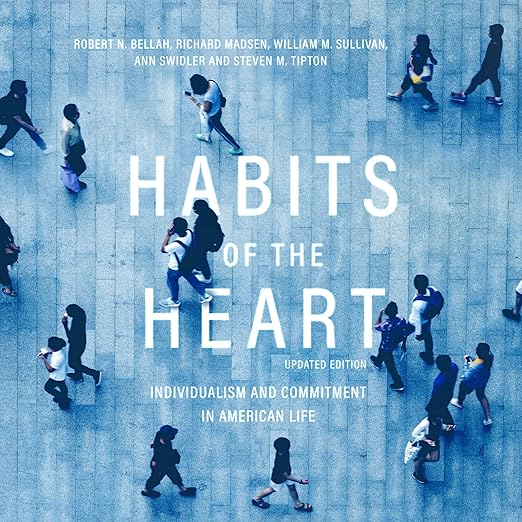
The problem was that this framework made commitment nearly impossible. If a relationship stops serving your self-development, you’re not just permitted to leave—you’re obligated to. The therapeutic language of “personal boundaries” and “self-care” made staying through difficulty feel like self-betrayal.
Bellah described couples who couldn’t articulate why they were together beyond “it just feels right”—and who therefore had no framework for staying together when it stopped feeling right. The commitment crisis wasn’t caused by dating apps. It was baked into how Americans learned to think about relationships.
5. Stiffed (1999) by Susan Faludi
Susan Faludi’s investigation into American masculinity might be the most prescient book on this list—though not always for the reasons she intended.

Through interviews with laid-off workers, veterans, and men from all walks of life, Faludi documented a generation who had lost the things that once provided meaning: stable employment, respected family roles, and a sense of useful purpose. The post-war promise—work hard, provide for your family, and society will honor you—had been broken. On this, she was exactly right.
Where Faludi’s feminist lens limits her analysis is in how she frames men’s responses. She describes men either withdrawing entirely or adopting “ornamental masculinity”—performance of dominance without substance—as if these were character flaws rather than predictable responses to genuine betrayal. Her categories of the “man-child” who refuses to grow up and the aggrieved young man drawn to extremism capture real phenomena, but they also pathologize men for reacting to conditions Faludi herself documents as devastating.
What’s missing is symmetry. The same economic and cultural forces that stripped men of traditional purpose also promised women that career success and independence would be more fulfilling than domestic life—a promise that has proven equally incomplete. Both sexes were sold a vision of liberation that left them lonelier. Faludi sees clearly how men were betrayed by shifting expectations; she’s less willing to ask whether the expectations that replaced them have served anyone well.
Still, Stiffed remains essential reading. The crisis Faludi identified in 1999 has only intensified, and her documentation of its early stages is invaluable—even if her interpretation requires a more critical eye.
What these books share
These five books tell a coherent story: Americans were sold a vision of freedom—freedom from tradition, obligation, and the constraints of community. We got that freedom. And we discovered that freedom from connection is just another word for loneliness.
The authors didn’t agree on solutions. But they all understood that the trends they documented—individual choice over collective obligation, the commodification of relationships, the erosion of shared frameworks for meaning—would eventually produce a society of isolated individuals who had forgotten how to be together.
We’re living in the world they predicted. The question is whether we can learn anything from the fact that they saw it coming.
Andrew King is the author of Costly Signals: The Evolution of Dating Advice. His research archive includes over 500 dating and relationship books spanning from the 1800s to the present day.
 Dating and Mating
Leave a comment