

A few years ago, the internet erupted with laughter over a 1958 McCall’s magazine article titled “129 Ways to Get a Husband.” Sparked by a Wisconsin woman’s Facebook post of her rummage-sale find, the list quickly went viral on platforms like Bored Panda, Psychology Today, and Reddit. Articles lampooned its outrageous suggestions—things like stowing away on a battleship, standing on a street corner with a lasso, or renting a billboard with your phone number—as peak examples of outdated, sexist 1950s dating advice. It became a symbol of how far society had come, with modern commenters contrasting it to today’s empowered, app-driven dating culture. This piece was something I uncovered while researching for my book Costly Signals: The Evolution of Dating Advice, where I explore how courtship guidance reflects deeper societal pressures and evolutionary strategies.
At first glance, the list does seem bizarre and deeply misogynistic: women are portrayed as scheming to “catch” a man through deception and helplessness. Standout oddities include “Stand in a corner and cry softly. Chances are good that he’ll come over to find out what’s wrong,” “Have your car break down at strategic places,” “Stumble when you walk into a room that he’s in,” or even “Bribe a Ferris wheel operator to get you stuck on the top.” Extremes like “Paint your name and number on the roof and say, ‘Give me a buzz, pilots’” or “Make and sell toupees—bald men are easy catches!” read like satire. It’s easy to dismiss the entire era’s advice as oppressive, reinforcing women’s sole value as wives in a patriarchal world.
Yet viewing these tips solely as strange or sexist is misleading—it ignores the historical context of post-World War II America. The war’s end brought a massive marriage boom, with couples wedding younger than ever (average age around 20 for women by the late 1950s) amid a cultural push for domestic stability and family life. While U.S. male war deaths were lower than in Europe, the era saw intense social pressure on women to marry quickly. Magazines and experts emphasized marriage as women’s primary path to fulfillment and security in a time when female independence was limited. More importantly, demographic shifts created a perceived “man shortage” in marriageable ages due to wartime disruptions, encouraging women to be proactive. The McCall’s list, compiled via “brainstorming” from ideas submitted by readers, reflects this urgency: women couldn’t wait passively; they needed strategies to increase encounters in a competitive market.
Pro-social advice
When we categorize the 129 tips (simplifying into broader themes), many reveal practical, even “pro-social” logic beneath the eccentricity—focusing on expanding social circles, signaling attractiveness and domesticity, and navigating gender norms intelligently.

One major category is strategies for meeting men in male-dominated spaces. Tips like joining a hiking club, taking up golf, attending night school in “courses men like,” or getting a job demonstrating fishing tackle urge women to pursue hobbies and careers where eligible bachelors congregate. Others suggest researching census data for high-male-ratio areas (like Nevada’s 125 males per 100 females) or volunteering for jury duty. These aren’t manipulative; they’re pragmatic ways to boost odds in a society where workplaces and leisure were often segregated.
Another group emphasizes appearance and feminine appeal. Advice like wearing high heels (“they’re sexier”), getting a sunburn for a healthy glow, practicing flirtatious eye contact in the mirror, or dressing differently from office peers highlights signaling youth, health, and availability—timeless cues in mate selection. Tips to laugh at his jokes, tell him he’s handsome, or learn to bake apple pies demonstrate wife-like qualities, showing compatibility for the era’s ideal of homemaking.
Social network and family integration tips encourage leveraging friends (“Ask your friends’ husbands who the eligible men are”) or being nice to everyone (as “they might have a brother or son”). Ingratiating with his family—sending his mother a birthday card or asking for recipes—builds alliances, practical in a time when extended family approval mattered.
Behavioral and mindset advice promotes adaptability and mystery: be flexible on dates, hold back personal details initially, avoid seeming desperate (e.g., “On the first date tell him you aren’t thinking of getting married”), and prioritize marriage over career. Even pointing out that “the death rate of single men is twice that of married men” nudges health benefits of wedlock. These reflect a pro-social push toward stable unions in a baby-boom society valuing family.
Practical advice for the era
Of course, the contrived ploys (crying softly, “accidentally” scattering purse contents) and wild extremes feel absurd today, but many tips boil down to being outgoing, groomed, and strategic—advice not entirely alien to modern dating coaches.
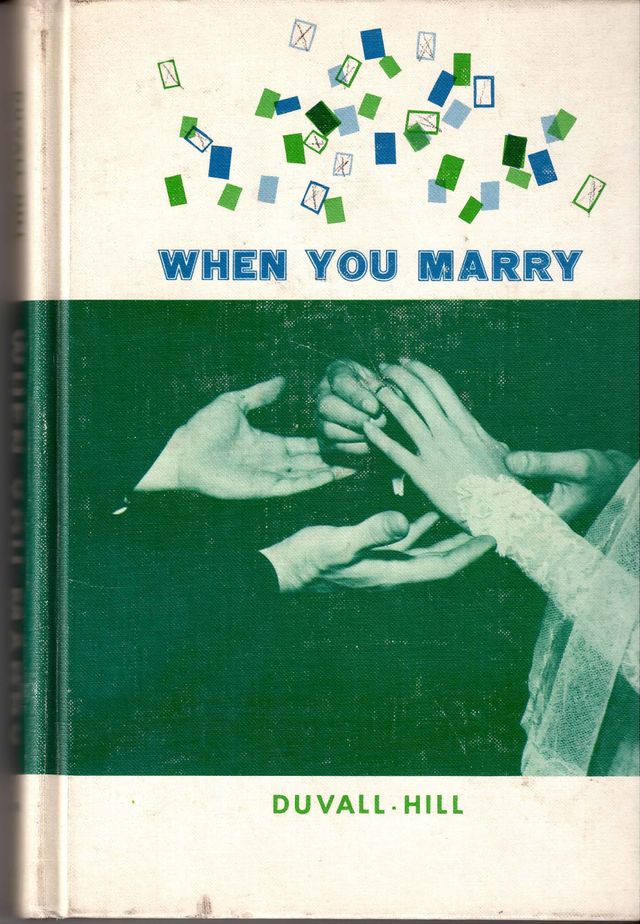
For a more nuanced view of 1950s guidance, popular advice went beyond gimmicks to research-based, thoughtful preparation. A prime example is Evelyn Millis Duvall and Reuben Hill’s 1953 book When You Marry (revised edition), a widely used text for marriage education courses. Drawing on sociology, psychology, and emerging family research, it stressed preparation over tricks.
In the preface, the authors note, “Getting married and raising a family today require advance preparation. Most couples want their marriages to succeed. But wishing happiness is not enough. Marriages that have been preceded by study and careful mate selection and which are followed by skillful handling of adjustments have high success rates.” They advocate a “functional” approach, starting “where the person is” and addressing real questions about personality, love, adjustments, and family life cycles.
The book integrates “proven principles and valid scientific concepts,” including new census data and research from national conferences. It covers everything from what individuals “bring to marriage” (personality, habits) to broader societal changes in family structures. As they write, “We have tried to keep the book close to the realities of life,” with check tests, illustrations, and suggestions for counseling and self-study.
Unlike the McCall’s list’s lighthearted (or desperate) tactics, When You Marry promoted informed, equitable partnerships grounded in mid-century science—reflecting a serious effort to build lasting families amid postwar optimism.
Ultimately, 1950s dating advice, viral quirks and all, mirrors an era’s anxieties and aspirations: rebuilding society through marriage in uncertain times. While much feels outdated, it reminds us that courtship guidance always evolves with cultural needs.
Andrew King is the author of Costly Signals: The Evolution of Dating Advice. His research archive includes over 500 dating and relationship books spanning from the 1800s to the present day.
 Dating and Mating
Leave a comment