

Attitudes, practices and data from the “Me Generation”
Our very liberal attitudes toward sex have their origins in the “swinging sixties,” but it was during the 1970s that a more outlandish sexual culture emerged. While “sexual liberation” first manifested itself through pop icons and the developing culture of concert-driven, drug-fueled utopic music festivals of the 1960s, the following decade brought us new subcultures and cultural forms focused around sex. Enter swingers clubs, mainstream pornography, girlie magazines, and Playboy celebrities.
As creative and fascinating as those times were, the economic constraints on society were being felt in the oil crises of the early 1970s and the sudden devaluation of the dollar (as a result of the United States coming off the gold standard in 1971). The ethos of sexual liberation lived on, despite the temporary end to the prosperity of the previous decade—mainly through radical feminism and the emergence of “sexual cultures” found in swingers groups, gay bars, and straight pickup venues.
This post looks at how cultural changes affected the everyday sexual behavior of the so-called “me decade.” The data comes from a 1974 book written by Morton M. Hunt titled Sexual Behavior in the 1970s. Though liberal in its outlook, Sexual Behavior resurveys some of the same terrain that the Kinsey’s studies covered in 1948 and 1953.
The Playboy Foundation commissioned the survey with the goal of utilizing the results to advance sex education. Findings were based on surveys of married and unmarried men and women across the United States, asking questions about their backgrounds, religious influences, occupations, sexual practices, and attitudes toward relationships.
Sexual culture in the 1970s
The book’s introduction provides a compelling rationale for the study, citing examples of some of the cultural changes taking shape during that decade:
The nude female breast, formerly portrayed only in trashy or arty magazines, has become an everyday sight in family, fashion and men’s magazines, and the hairy female pubis, which had always been rigorously hidden even in nudism literature, made its mass-circulation debut in the January 1972 issue of PLAYBOY. Other magazines have followed suit and gone on to male frontal nudity….
In “soft-core” X-rated films, virtually every sort of sexual act was openly portrayed, through erection, intromission and orgasm were simulated or suggested rather than pictured in actuality; in “hard-core” blue movies, however, full-color close ups of erect penises penetrating every available orifice, and freely spurting semen, were being exhibited publicly in erotic movie houses not just in New York, Los Angeles, Chicago and San Francisco, but in Des Moines, Kansas City, Nashville, Dallas, Denver and a number of other cities.
Films like Last Tango in Paris (1972) reflected the change in film culture to some extent; the entire plot, for instance, focused on two strangers making out over the course of a week in a sordid Paris hotel.

Restrictions on printed publications were being lifted too, with the word “fuck” being included in the Oxford English Dictionary for the first time in 1972. The Sensuous Man (1971) and The Sensuous Woman (1969) were two classic sex manuals written at that time (by authors simply known as “M” and “J”). The Sensuous Man includes a good deal of information about male sexuality, covering topics like penis size, impotence, and premature ejaculation. Here are a few excellent excerpts from The Sensuous Man, illustrating in very plain English the role of the clitoris and vagina in sexually pleasuring women:
To test for lubrication, insert one or two fingers in the vagina. If she is wet inside, you may now excite her further by stimulating the in-and-out motion of the penis with your fingers. Pay particular attention to the upper part of the vagina near the entrance, so you can indirectly stimulate the clitoris as well.
The depictions of sex were very new too, exploring the dynamics of particular positions in fairly explicit detail:
She kneels and bends forward, resting her elbows across a couch or hassock. You stand behind her. Have her raise her buttocks as high as possible and then put your penis into her vagina. Your two hands are free and can now be used to excite her breasts and clitoris as you go—right—you guessed it: in and out of her vagina. The greatest depth of penetration is effect utilising this position. There is also an unmatched feeling of power as you hold her hips tightly against your groin, her body helpless to resist your thrusts.
So with these kinds of materials circulating within the culture, was it true to say that a revolution was truly under way? What activities were typical among ordinary couples—were they all swingers and sex addicts, as some advocates of sexual libertarianism might suggest?
Premarital sex
According to the survey, one of the most significant changes in attitudes towards sex is the shift away from a prudish mindset regarding premarital sex. The Kinsey survey omitted data on premarital sex, reflecting a more conservative time; other surveys between 1937 and 1959 show general disapproval—22% found it acceptable for both sexes and 8% for men, with almost 80% disapproving for either sex.
Figures from the Sexual Behavior in the 1970s show a significant shift towards a greater acceptance of premarital sex. Anywhere between 60 and 84% of the men surveyed said that it was acceptable for women to engage in sex before marriage. Overall women were less permissive in their attitudes—between 37 and 73% said it was OK for men, and a slightly lower 20 to 68% said it was acceptable for women.
By contrast to the more liberal 1970s, the study cites Kinsey to show just how conservative the 1940s were regarding premarital sex—well over “one-quarter of unmarried American males had not yet experienced intercourse by age 25.” This means that more than a quarter of unmarried men were still virgins by the age of 25! In contrast, the report indicates that by the early 1970s, the figure had dropped to as low as just 3%. “The more significant increase in premarital intercourse,” the study proudly claims, has “taken place among females. One-third of females (single and married combined) in Kinsey’s sample had had premarital intercourse by the age of 25, as compared with over two-thirds in our sample.”
Permissiveness with affection
The emerging liberal narrative was clear: “The double standard [regarding female sexual permissiveness] has been relegated to the scrap heap of history.” But to show that this was actually the case, the data included some intriguing caveats. The slut-shaming tendency of women in previous generations was under attack, led by feminist activists—but it was still women themselves, and not men, who were the ones most resistant to this change. In social science surveys, women were somewhat more conservative in their stated views about sex.

This is nothing new, but the book presents data in a way that leads the reader to believe that slut-shaming has become obsolete. Attitudes to premarital sex were measured via responses to the following question: “Do you think it is all right for either or both parties to marriage and have had previous sexual intercourse?” The response should be unambiguous, either affirmative or negative. But the answer shows a 20 to 68% range of women approving of sex before marriage, which is a fairly sizeable gap. The clause “[d]epending on the degree of affection or emotional involvement between the partners” was added; this makes it more desirable for women to answer yes to that question. The degree of understanding regarding the term “emotional involvement” varies for each woman, of course.
“Emotional involvement” will mean different things to different women, but the study draws upon the work of sociologist Ira Reiss to explain what it might mean in the context of the sexual liberation movement. Given the increasing acceptance of sex parties and swingers clubs in the 1970s, women’s more liberal attitudes towards sex could be understood as a form of ‘permissiveness with affection’:
Young women are more likely than their mothers to believe they have the right to a complete sexual life before marriage; however, they exercise that right with emotional consideration rather than in a lighthearted and purely physical manner. The inhibitions experienced by the demi-vierge of the 1940s have been replaced by sexual freedom that exists within the boundaries of emotional involvement, which has become the new norm of being, in sociologist Reiss’s words, “permissiveness with affection.”
Though the data showed an increase in women becoming more approving of uncommitted, premarital sex, it also still indicated a preference for some form of commitment. This seems paradoxical but allows for some to adapt to the new cultural norms of permissiveness. Women in the 1970s, as the book shows, seemed to be enjoying greater levels of sexual freedom, but that sexual freedom always came with “emotional ties.” Sexual liberation was certainly appealing to some women back then, but “in relative terms it remains true that most sexually liberated single girls feel liberated only within the context of affectionate or loving relationships.”
The female orgasm
With all of this positive talk of promiscuity and the belief that it would lead to women having more satisfying lives, the study contains very little data measuring satisfaction—either during sex or in life more generally. The data does show that 1970s men and women were practicing fellatio and cunnilingus more often, but it doesn’t show how satisfied they were with their husbands or wives, sexually or otherwise. It’s fascinating to note that the average time spent in foreplay among married couples had increased from 1938-49 to 1972 by just 3 minutes.
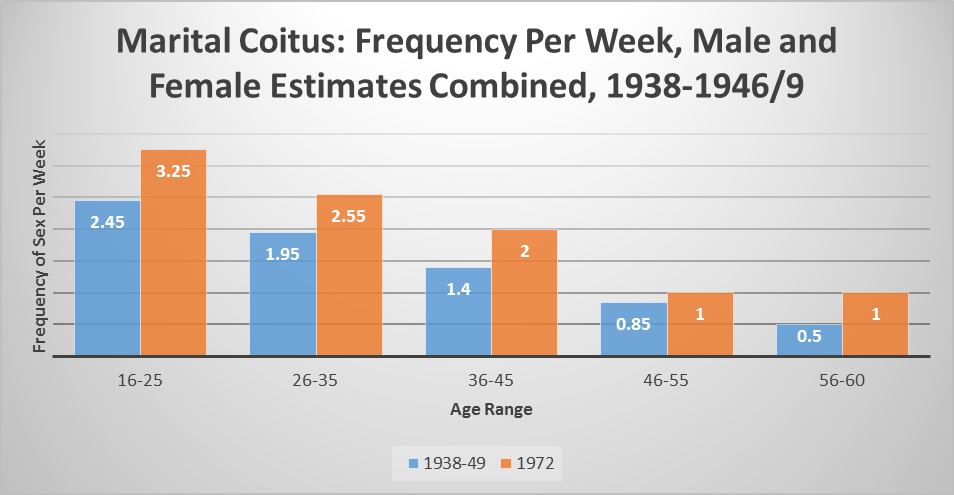
I thought I’d insert some data porn here, only to illustrate a point these kinds of sexology studies often (‘controversially’) like to make—that couples are having more sex than they did in earlier generations. The authors of the study are keen to illustrate that the younger cohort (ages 16–25) was having sex more than 3 times per week in the 1970s, an increase from just under 2 and a half times per week in the 1940s, while the 26–35-year-old cohort was enjoying sex over 2 and a half times per week in the 1970s, compared to less than 2 times per week two decades earlier.
All that is wonderful, of course, but let’s not forget that the earlier generations were working harder and had less recreational time to enjoy sex, given that the country was also involved in a war. It is a positive indication that couples were able to find any time for intimacy in the first place.
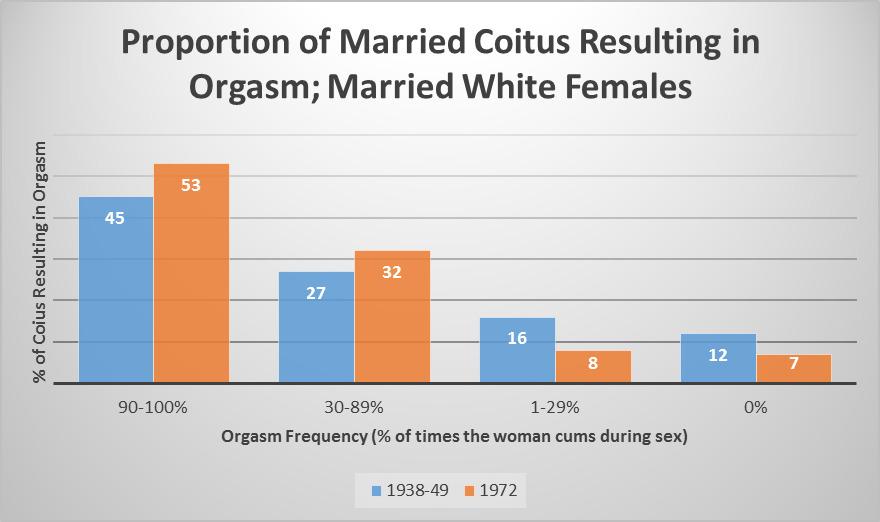
It’s no surprise to find that married women in the 1970s were reaching orgasm more often than their mothers’ generation, as the following chart shows. But everything is relative, of course, and the fact that the data also shows almost half of the women in the 1940s reaching orgasm almost 100% of the time with their husbands was not such a bad thing either.
Marriage and orgasm
Reading through all the data, one thing stands out when contemplating the narrative of sexual liberation presented throughout the book—married women have far more orgasms than single women. This is something that Kinsey also noted:
Whether or not women had had premarital coitus, however, Kinsey found their orgiastic regularity increasing with the duration of the marriage and continuing to improve even up to the twentieth year of marriage, a phenomenon most experts attributed to such internal processes in the marriage as the growth of intimacy and trust, growing familiarity of the partners with each other’s physical needs, the slow wearing away of inhibitions, and the growing willingness of the wife to learn from the husband and to make little experiments at his suggestion.
Although this view seemed more outdated with the emergence of second-wave feminism, the data showed that there was only a slight increase in rates of female orgasm in marriages from previous generations—about 8% overall.
Looking back to the pre-sexual revolution days, it’s easy for researchers to characterize women as victims of very unsatisfying encounters with their oafish husbands. Many theories were developed around the issue of female orgasm in marriage, with Freudians suggesting that non-orgasmic women maintained a mental resistance to being dominated sexually by a man. As Sexual Behavior in the 1970s notes, with both psychological accounts and popular relationship books over the years, the onus has always been placed on the man for either being too quick or not knowledgeable enough about his wife’s anatomy to pleasure her properly.
With all the promise of sexual liberation in the 1970s and the politics of radical feminism in the air, the data showed that women still enjoyed sexual intimacy within—rather than outside of—a committed relationship. Much of the discussion around ‘permissiveness with affection’ continues today, suggesting that promiscuity is a social—much more than a biological—hurdle to overcome.
Sexual Behavior in the 1970s: the legacy
Data from Sexual Behavior in the 1970s is interesting, and it certainly depicts society’s changing attitudes towards sex. The report welcomes permissive forms of sexual activity, characterizing them as beneficial for both women and men.
Sexual Behavior in the 1970s also embraced pickup culture as a reflection of these changes and, compared with attitudes today, embraced pickup artistry in a much more egalitarian way. Men picking up women was seen to be just as acceptable as when women chose to pick up men—however and wherever they did it.
Andrew King is the author of Costly Signals: The Evolution of Dating Advice. His research archive includes over 500 dating and relationship books spanning from the 1800s to the present day.
 Dating and Mating
Leave a comment